YOUR TO-DO LIST
Tasks, quizzes, and modules assigned to you. Click an item to start it. Custom tasks can be marked done manually.
Resource Library
Everything you need to sell JB Trailer Service — scripts, objections, discovery guides, value props, battlecards, and the team handbook.
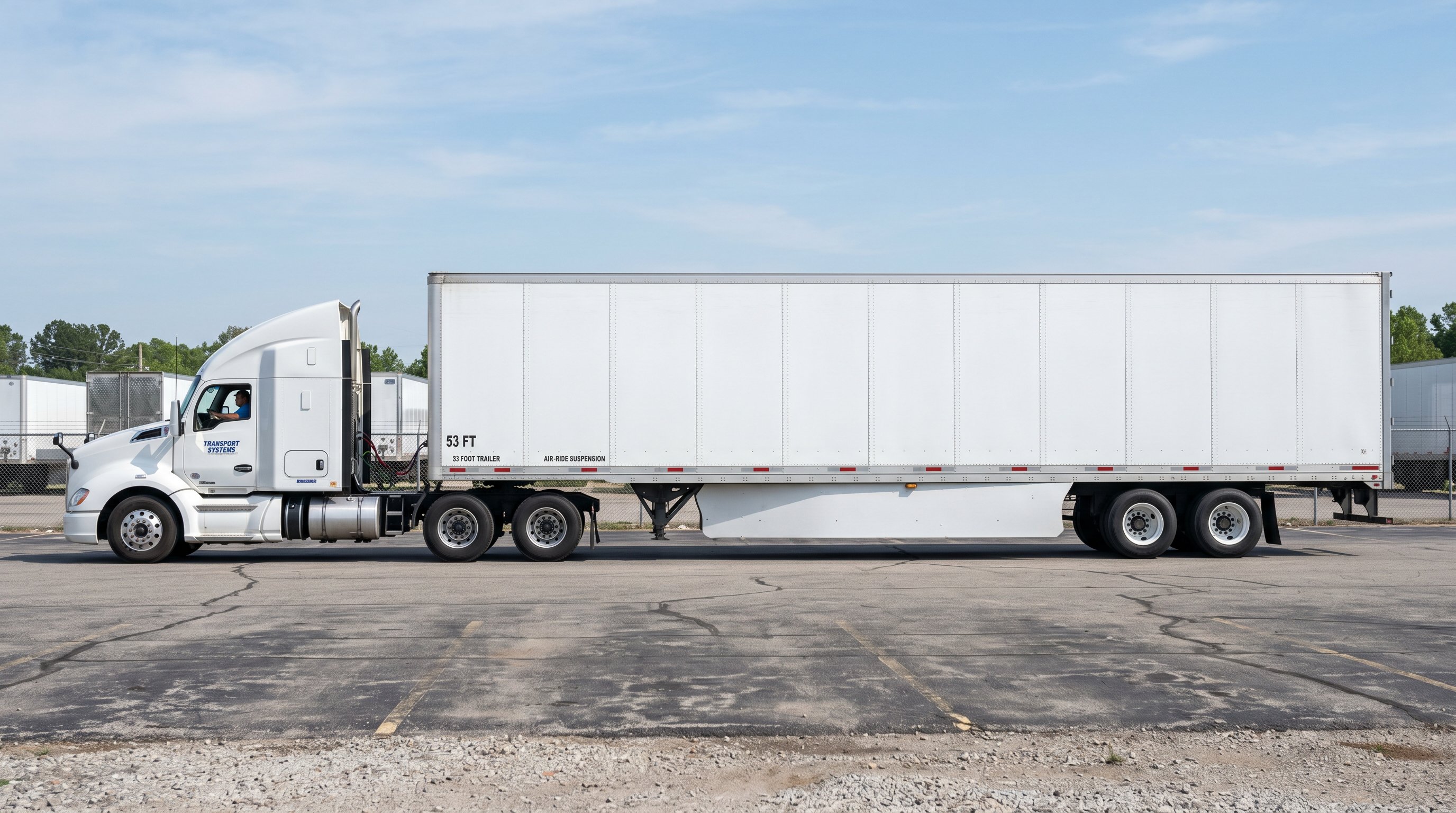
A semi-trailer is the cargo-carrying half of a tractor-trailer combination. It has no front axle — the front of the trailer rests on (and is pulled by) the tractor truck. Your trainees will mostly see 53-foot dry vans, the standard freight box on US highways.
Key dimensions to know cold:
- 53 ft long × 8.5 ft wide × 13.5 ft tall — federal max for a standard trailer
- ~80,000 lb GVW — combined truck + trailer + cargo legal limit
- Most carriers run 53-foot dry vans or 48-foot reefers
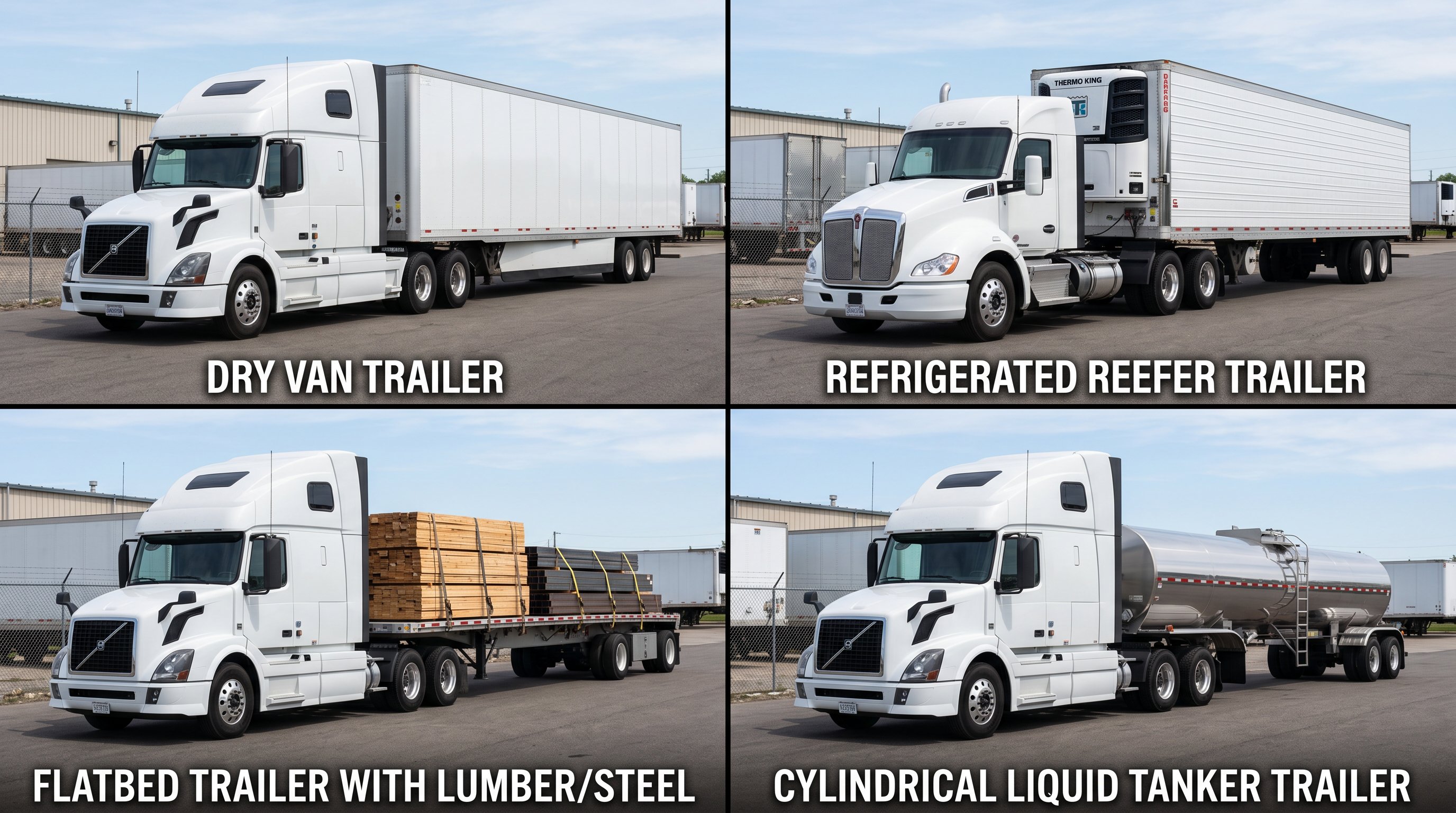
Not all trailers are the same. A rep needs to know which type the fleet runs because PM cadence and failure modes differ.
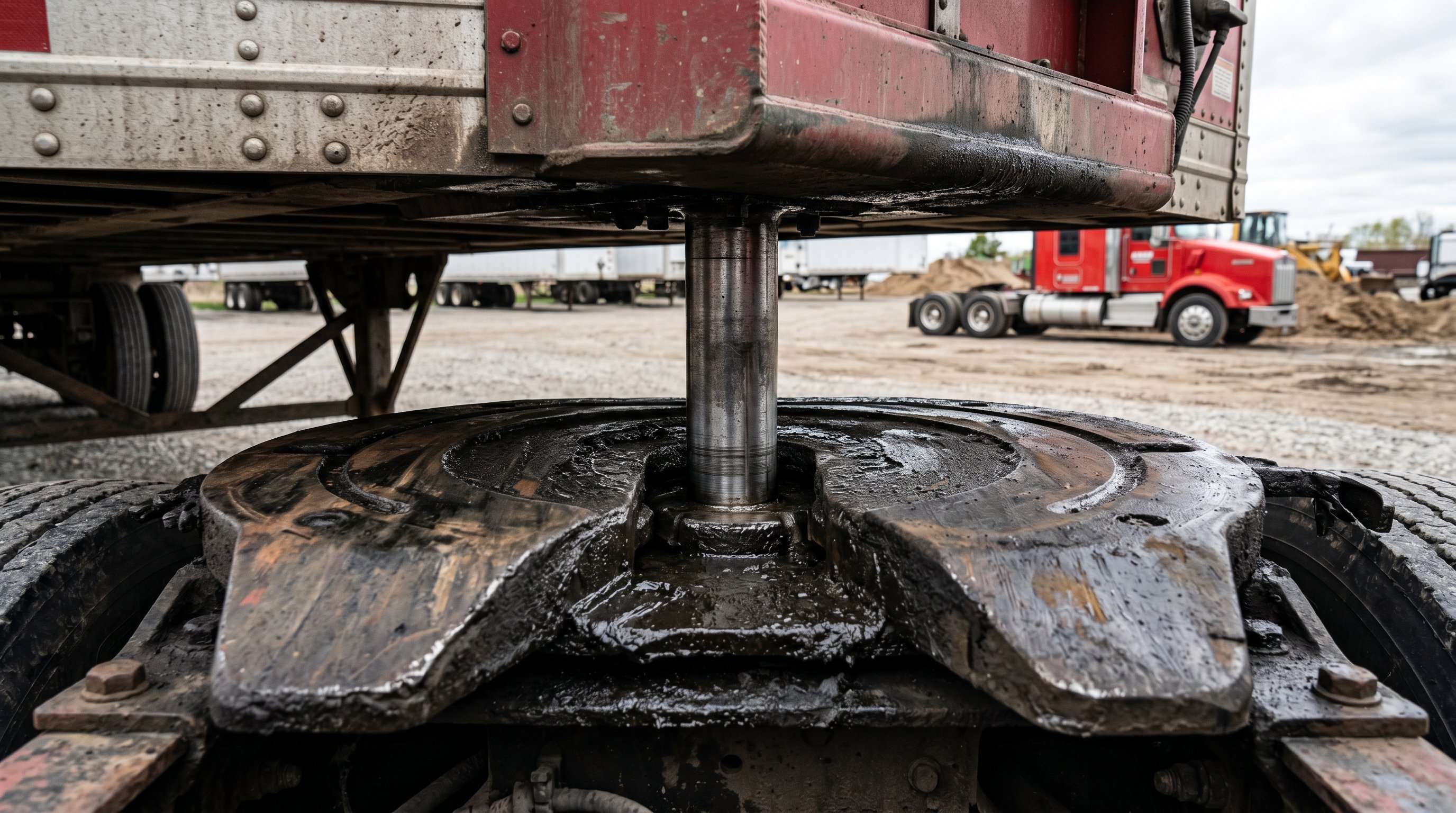
The kingpin is a 2- or 3.5-inch vertical steel pin protruding from the underside of the trailer's nose. The fifth wheel is the horseshoe-shaped plate on top of the tractor that locks around the kingpin.
This is the only thing holding the trailer to the tractor. If it fails:
- The trailer detaches at highway speed
- It's catastrophic — vehicles, lives, freight
- It's also one of the most overlooked PM items because it's out of sight
Wear, cracks, or improper coupling are the failure modes. Kingpin inspection is part of standard PM.
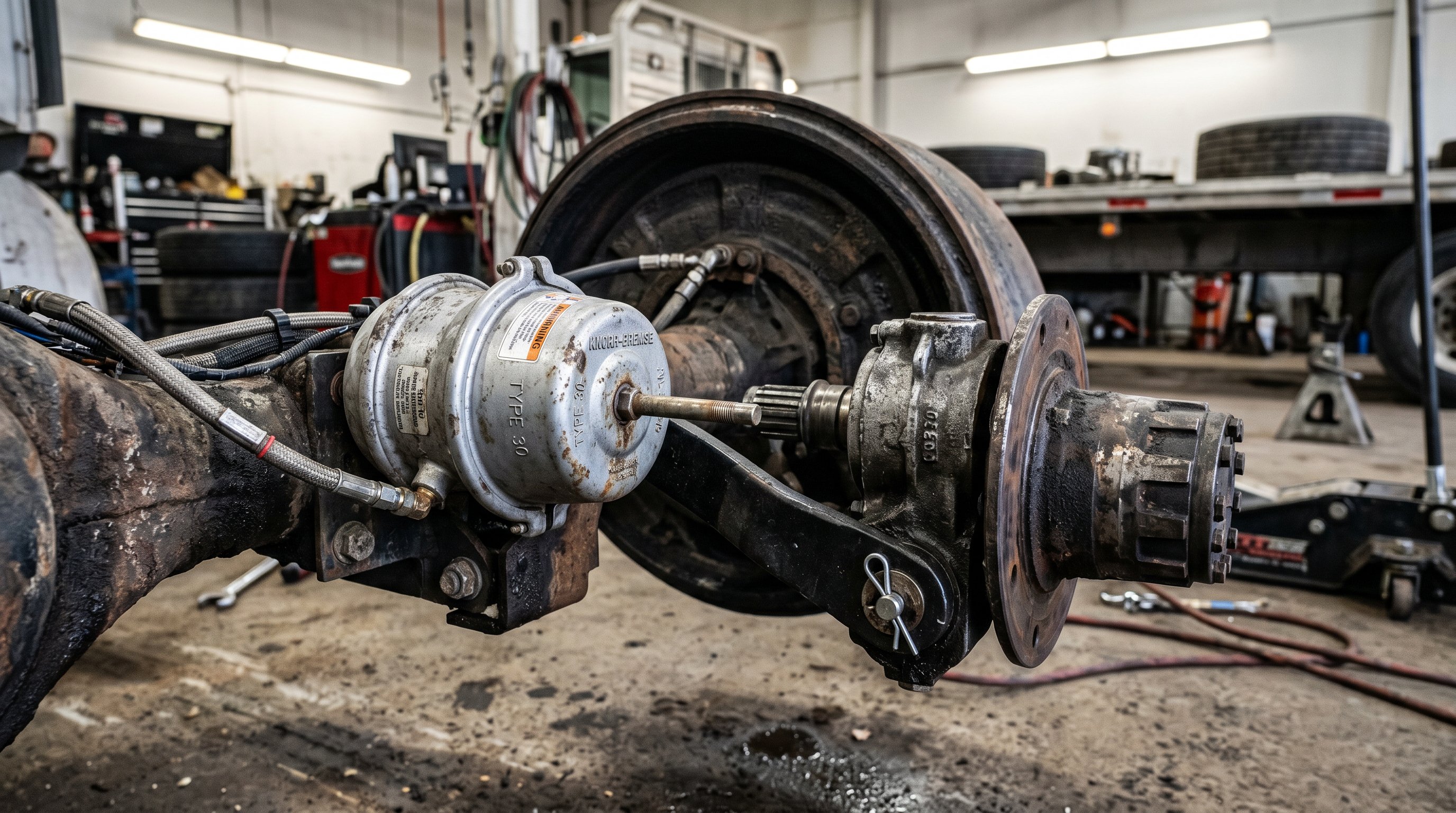
Trailer brakes are air-actuated drum brakes. Each wheel has:
- Brake chamber — converts air pressure into mechanical force
- Slack adjuster — sets how much travel before the shoes contact the drum
- S-cam — pushes the shoes outward into the drum
- Brake shoes & drum — the wear parts
Why brakes drive PM:
- Brakes are the #1 DOT inspection violation (out-of-adjustment, missing parts, wear)
- Brake failure is the #1 cause of major crashes involving commercial trailers
- An out-of-service violation puts the trailer out of work — instant downtime
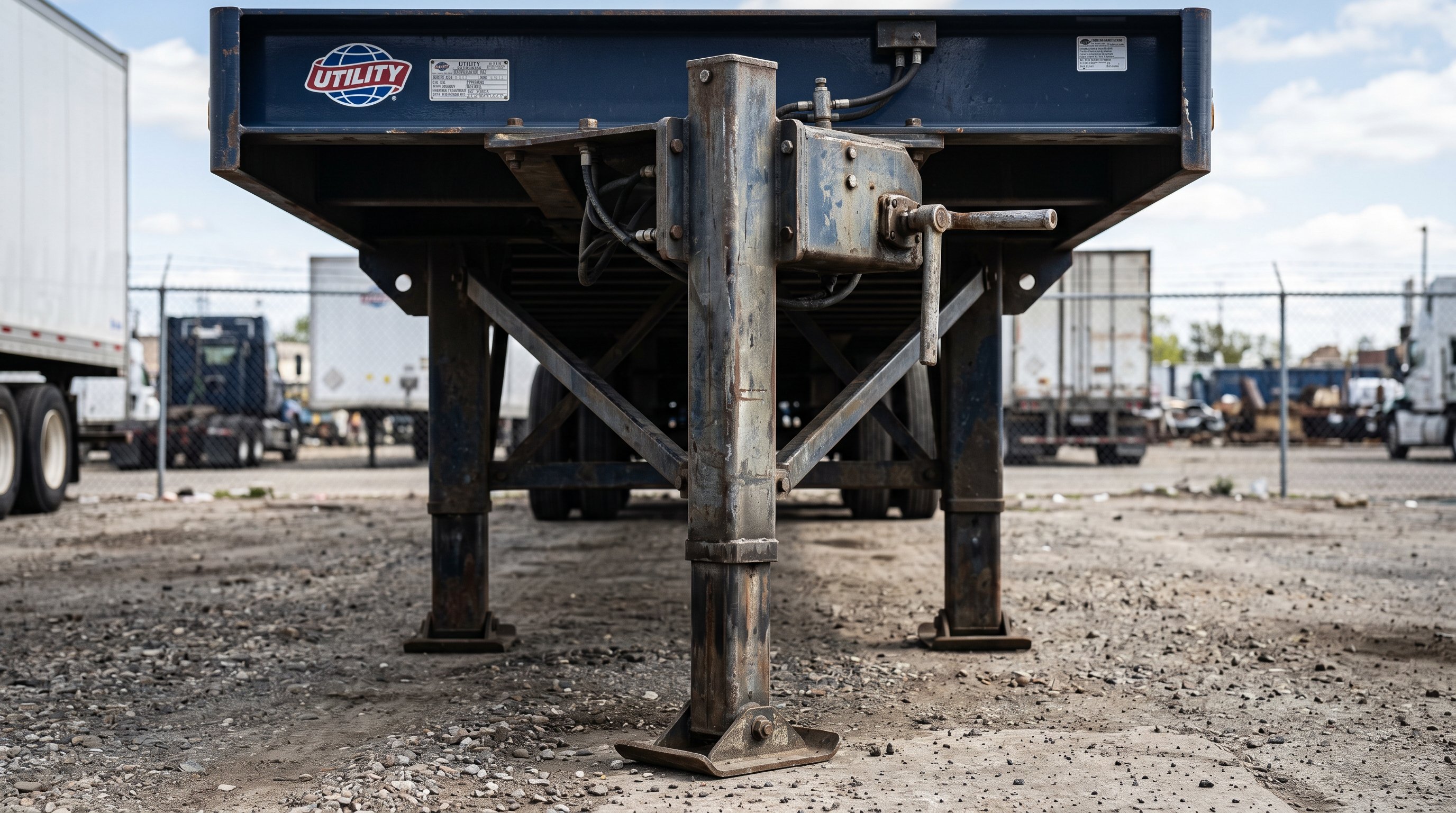
When a trailer is disconnected from the tractor, it sits on its landing gear — two retractable legs on the front underside. The driver cranks them down before unhooking and cranks them up before driving away.
Common failure modes:
- Bent legs from driving away with them still down (driver error, common)
- Worn crank gear — driver can't lift them, trailer can't be picked up
- Frozen mechanisms in winter
A trailer with broken landing gear is stuck. It can't be moved without expensive recovery equipment.
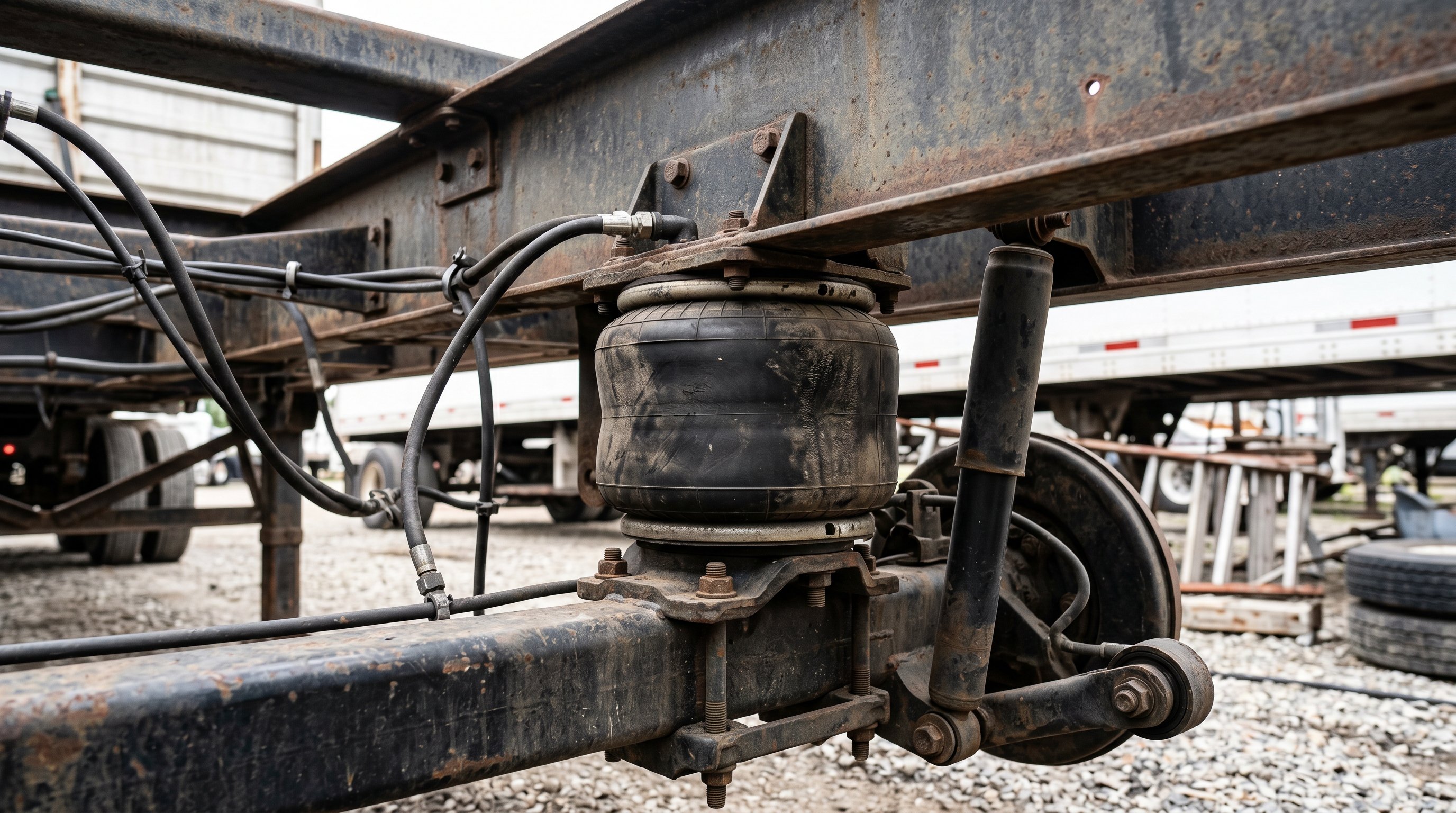
Most modern trailers use air-ride suspension: rubber air bags between the axle and the frame that cushion the ride and protect freight from shock damage.
What can go wrong:
- Air bag failure — bag splits or leaks; trailer rides on the bump stop = harsh ride, freight damage, eventual frame damage
- Height control valve failure — trailer rides too high or too low
- Air line leaks — trailer slowly settles overnight
Air ride is also what carriers pay extra for when hauling sensitive freight. A reefer hauling produce with a failed air bag is a bumpy, damaging ride.
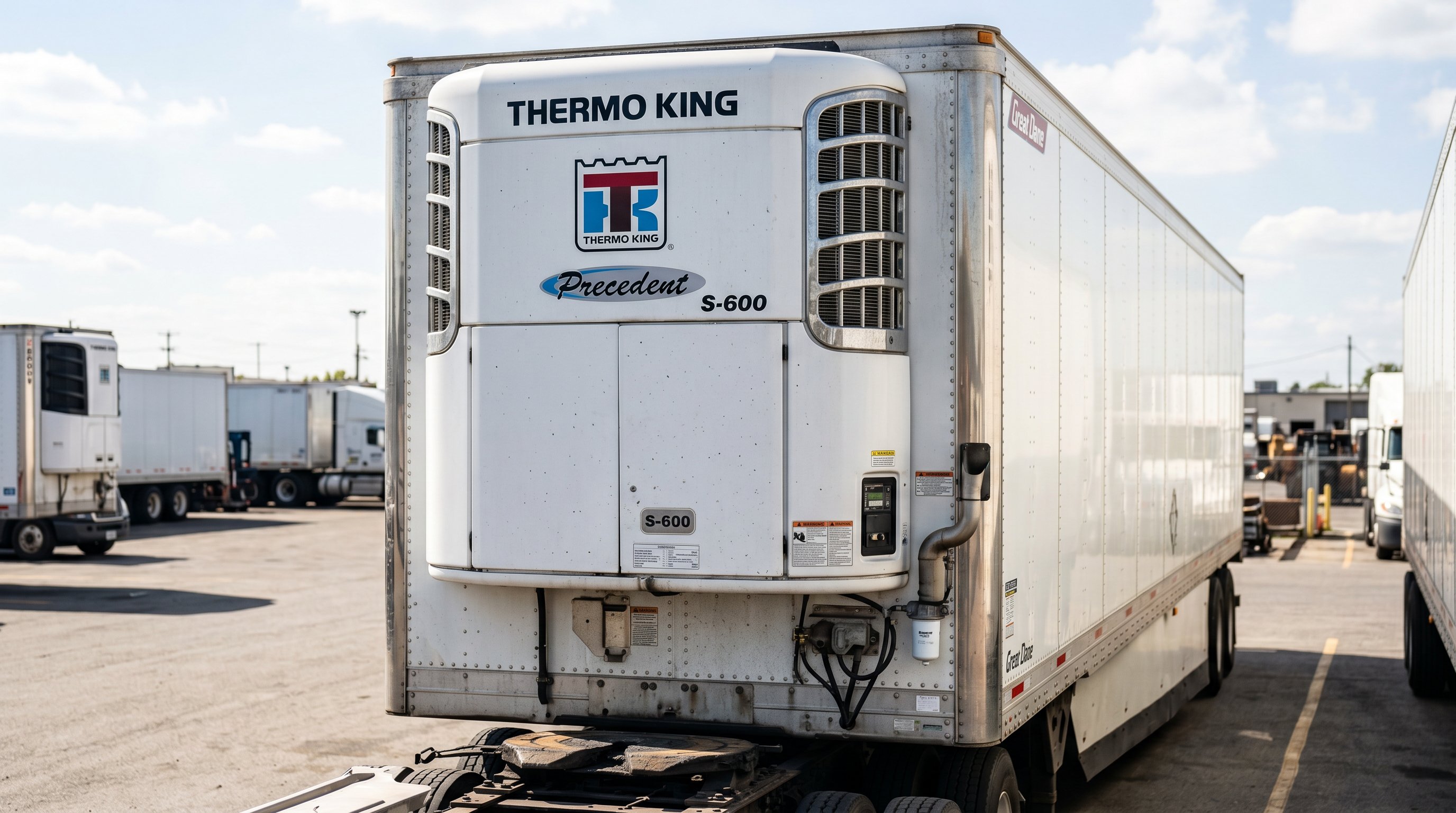
A reefer trailer has a refrigeration unit mounted on the nose — typically Thermo King or Carrier branded. It runs on its own small diesel engine.
Why reefers are the highest stakes:
- A failed unit during a haul = total load loss ($50K-$200K per trailer)
- Temperature deviation can = the entire load gets rejected at the receiver, even if it never went bad
- Carriers must log temp continuously (FSMA / Sanitary Transport rule)
The reefer unit is a separate maintenance item — its own engine, its own filters, its own service intervals — on top of the trailer itself.
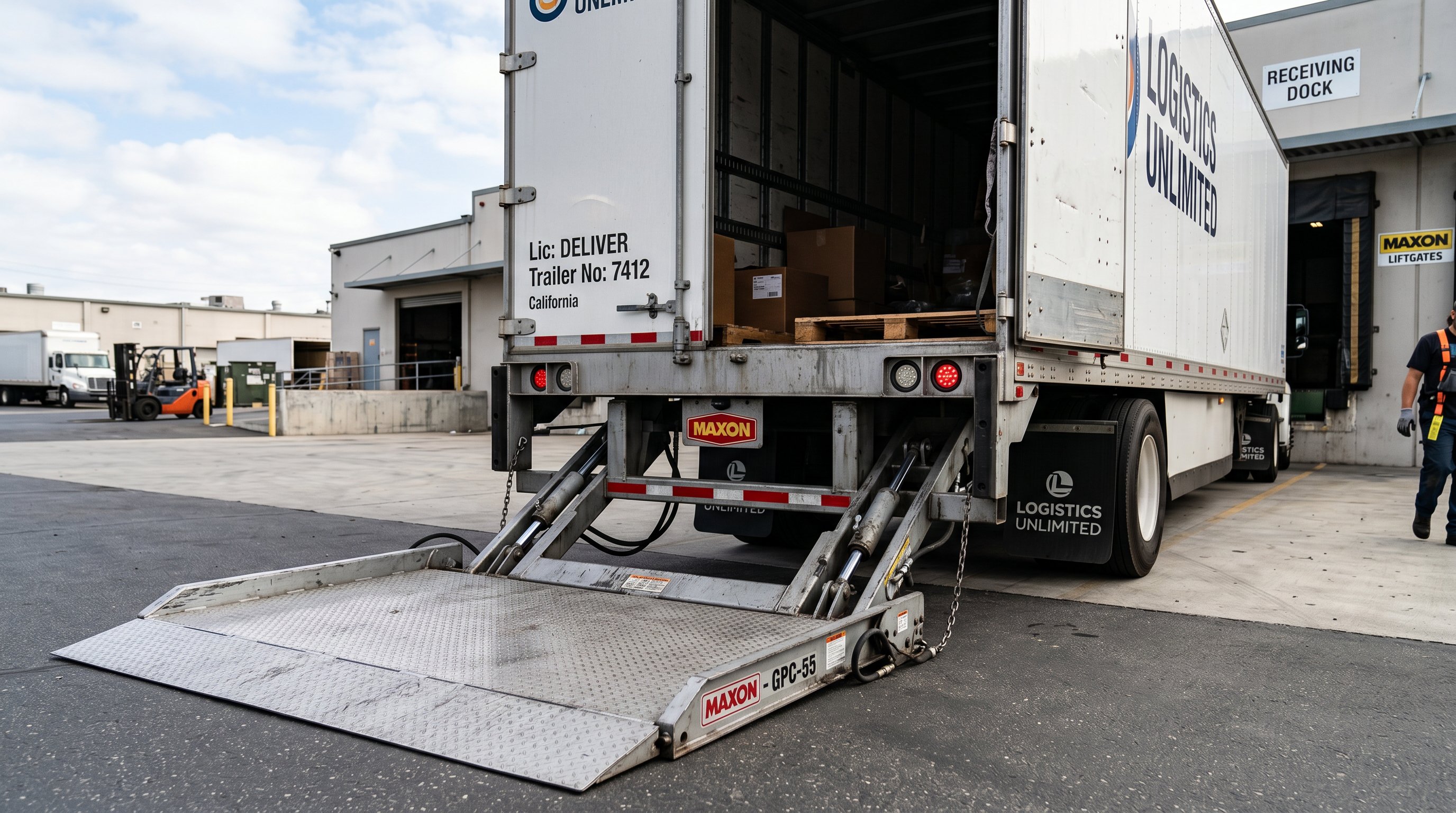
A lift gate (or "liftgate") is a hydraulic platform at the back of the trailer that raises and lowers freight to ground level. Essential for any delivery to a location without a dock (storefronts, residential, small shops).
What fails:
- Hydraulic leaks — gate won't hold position
- Motor / pump failure — gate won't move
- Frame cracking — overloading or impact damage
A broken lift gate stops deliveries entirely on routes that need it. LTL and last-mile carriers depend on these.
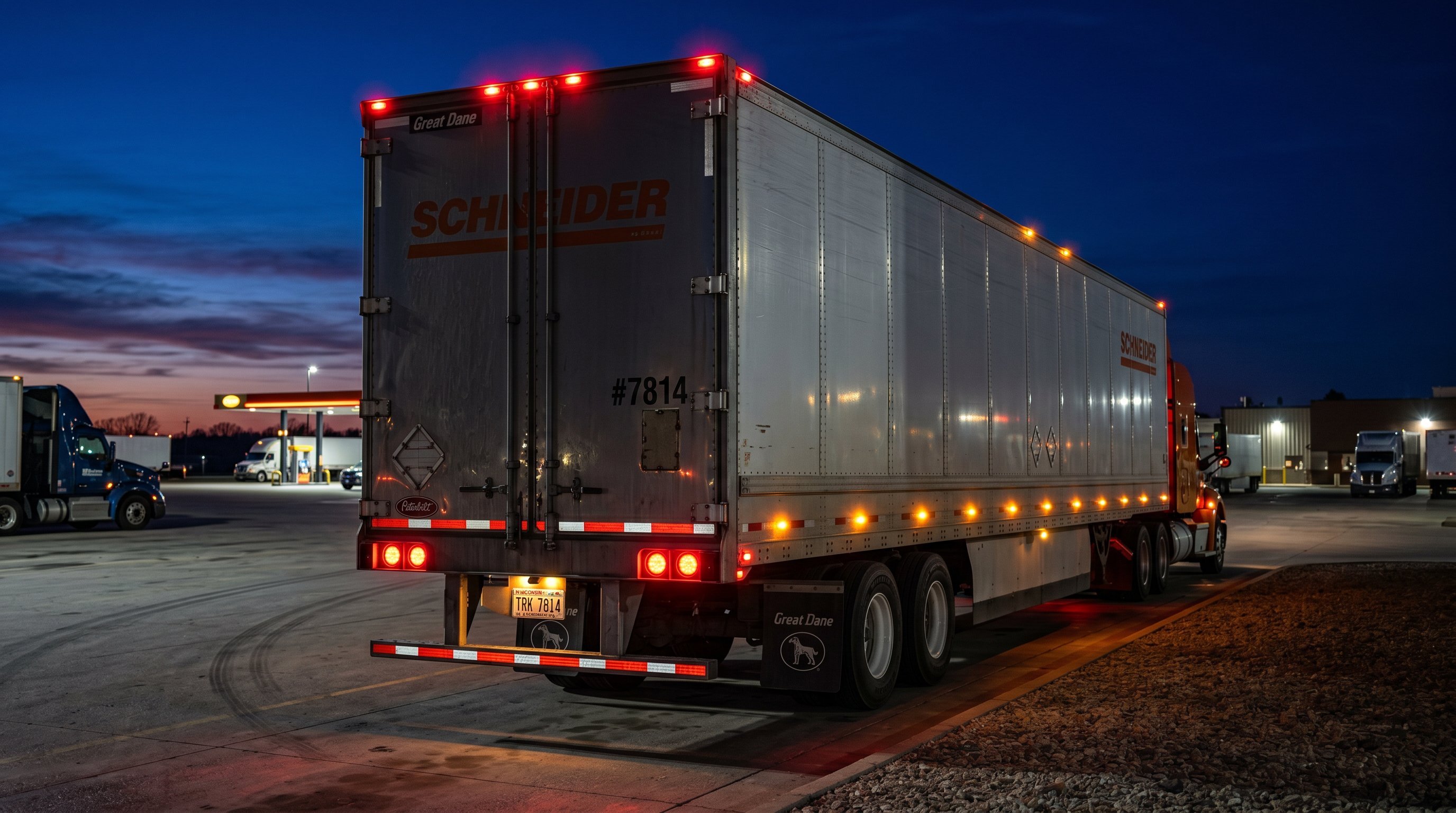
Every trailer has a complex lighting system:
- Marker lights — amber on the sides, red on the back, define the trailer's outline at night
- Brake / turn / tail lights — required by federal law
- Reflective tape (conspicuity tape) — red/white striping required on sides and rear
- License plate light — illuminates the plate
Lighting violations are the #2 most common DOT inspection finding after brakes. A single burnt-out marker can put the trailer out of service.
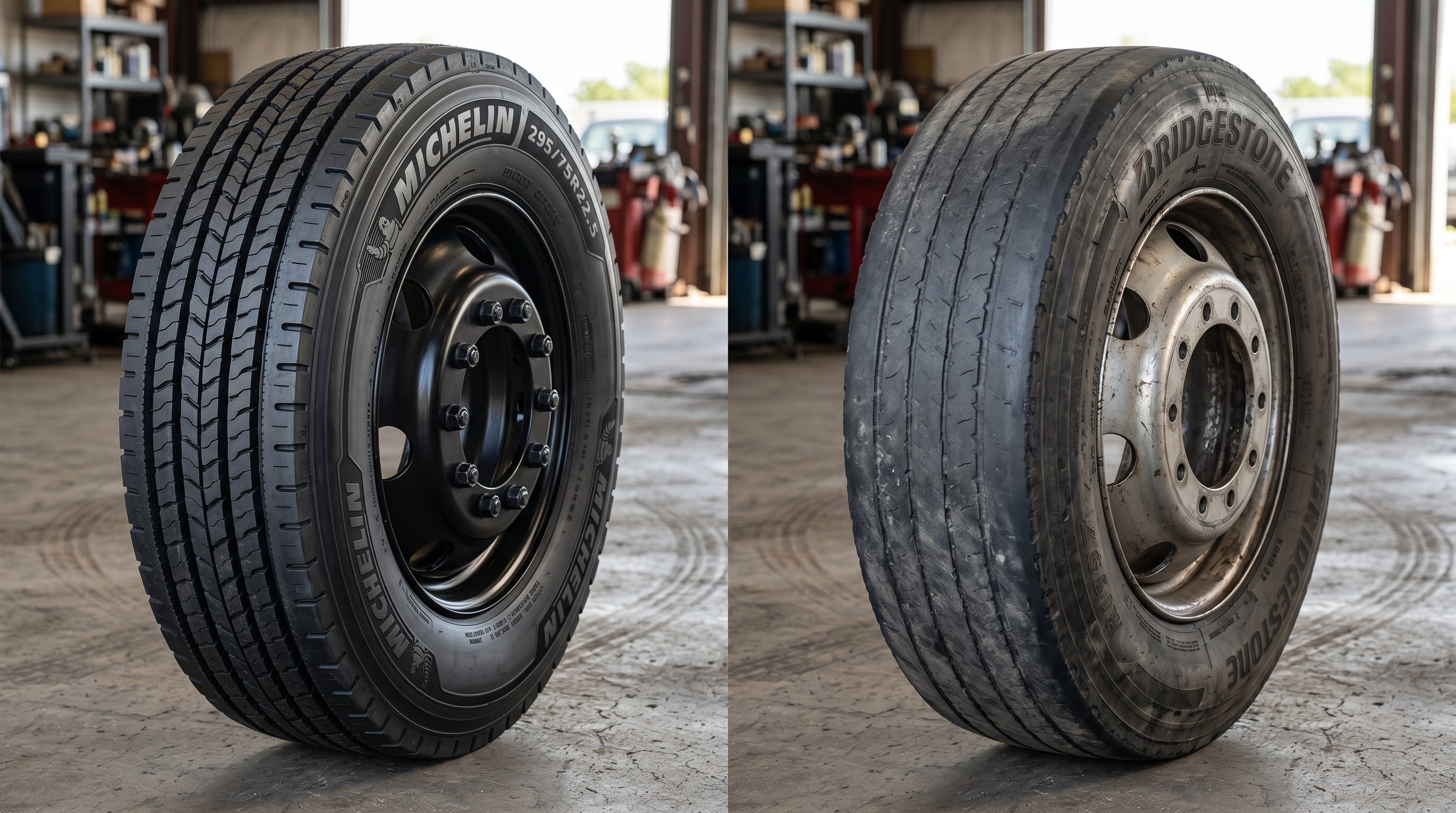
A semi-trailer has 8 tires (typically). Tires are the single largest consumable cost in any fleet. Trailer reps need to recognize wear patterns because they signal other problems:
- Center wear — over-inflation
- Edge wear (both sides) — under-inflation
- One-side wear — alignment problem, bent axle, or worn bearings
- Cupping / scalloping — suspension problem
- Sidewall damage — curb hits, age, immediate out-of-service
A blowout on the highway costs ~$500 in tire + service, but also potential cargo damage and driver downtime.
Tread depth: must be ≥4/32" on steer (tractor) and ≥2/32" on drive and trailer — federal minimums.
Take the Trailers 101 quiz to validate what you just learned. 6 questions, sales-context — the kind of stuff that comes up on real discovery calls.
Training Notes & Transcripts
All your notes and full transcripts from completed training sessions, saved automatically.
Quiz Scores Over Time
Activity Breakdown
Average Score by Item
Recent Activity
RESTORE PRIDE AND
PURPOSE TO HONEST WORK
Your complete training platform for mastering trailer fleet sales — fleet types, industry knowledge, sales skills, and JB Trailer's Fleet Uptime Subscription.
- Fleet types: Small / Mid-Size / Reefer / Enterprise / Owner-Op / Flatbed
- Industry knowledge: About JB · Trailers 101 · Trucking 101 · Reading a Fleet · Carrier Economics
- Sales skills: Intro Calls · Discovery · BANT · Negotiation · Value Props · Open-Ended Q's · Follow-Up · NDM · 6 more
- End-of-training graded activities — emailed to manager
- Alex — Sales Director (objections, closing, discovery)
- Morgan — Fleet Operations Expert (trailers, DOT, reefer, lift gates)
- Jordan — JB Specialist (Fleet Uptime Subscription, pricing, onboarding)
- Voice input + ElevenLabs voice responses
- 6 fleet manager personas — Mike, Carlos, Sarah, Dave, Luis, Tom
- Each with unique voice, decision style, and pain
- AI-graded calls scored on discovery, objection handling, value-prop fit, close
- Transcript + grade emailed to manager
- Objections + battlecards on the 6 main IE competitors
- Pain points, discovery frameworks, value props
- Pitch scripts, call scripts, follow-up cadence
- Team handbook, software guide, FAQs
Objection Handling
Every objection has a real concern underneath. Lead with empathy, redirect to value, close with the next step.
Knowledge assessments
Test your knowledge on JB Trailer, fleet management, the subscription model, and selling to fleet operators. You will be scored, shown what you missed, and given resources to improve.
AI Sales Coach
Ask anything — objection handling, fleet industry knowledge, pitch help, discovery questions, the Fleet Uptime Subscription, pricing. Hold the button and talk, or type. Your coach responds in voice and text.
Interactive training
AI-led training sessions on contractor types, industry knowledge, and sales skills. Each session is about 30 minutes, fully interactive — your trainer asks questions, gives feedback, and adapts to your answers.
Sales Scripts
Word-for-word outreach scripts for fleet operators of every size. Use the structure — make the words your own.
- Lead with their pain, not your service
- Use "we" and "your" — partnership language
- Reference specific numbers (90-day, 60% breakdowns, $99 trip)
- Quote core values: "We Put Our Name On It"
- Always end with a specific next step + day/time
- Lead with "Let me tell you about JB Trailer"
- Use "I'll" — switch to "we'll"
- Promise things outside the tier (creates pricing chaos)
- Discount before you've defended value
- Say "follow up later" — give a specific day
How-To Playbooks
Step-by-step plays for running every type of JB Trailer fleet sales conversation.
The goal is not to pitch — it is to understand their world deeply enough that the pitch becomes obvious. Aim for 80% them talking, 20% you talking.
Open with a permission frame
"The goal today is to understand how you're handling fleet maintenance, where the pain points are, and decide together if there's a fit. This is a working conversation, not a pitch."
Establish their fleet shape
How many trailers? How many yards? Trailer/truck mix (dry van, reefer, flatbed)? Average age? In-house wrenches or all outsourced?
Probe how today actually works
"Walk me through what happens when a driver flags a brake issue on Tuesday morning — who handles the call, who decides where it goes, and how do you know it actually got fixed correctly?"
Find the financial pain
What's a typical monthly repair spend? Was last quarter higher or lower than budget? Have you had a roadside breakdown that cost a load in the last 6 months?
Find the operational pain
Who tracks PM compliance? When was your last DOT inspection — did anything come up? How do drivers report issues, and who actually closes the loop?
Confirm what you heard
"So if I heard you right — invoices are unpredictable, PMs are happening reactively not proactively, and your team is spending time chasing compliance instead of running the business. Is that the picture?"
Trigger question + next step
"If we could give you fixed monthly pricing, automated PM scheduling, a compliance dashboard your DOT team can use, and priority dispatch when something breaks — is that worth a 30-minute walkthrough? Thursday at 10 work?"
This is the most common objection. Most fleets DO have a shop. Your job is not to replace the shop — it's to position the subscription as a different model.
Acknowledge — never argue
"That makes sense. Almost every fleet we talk to already has a shop or two. I'm not asking you to fire anyone."
Reframe the question
"The question isn't shop vs shop. It's reactive vs predictable. Are your invoices predictable month-to-month, or do they spike when something breaks?"
Probe their compliance reality
"How are you tracking PM compliance across the fleet? Is there a dashboard, or is it spreadsheets and email reminders?"
Position as additive
"We can handle proactive PMs and compliance tracking — keep your existing shop for emergency repairs if you want. Most clients consolidate over time, but that's their choice, not the deal."
Make the cost comparison concrete
One unplanned roadside callout = $300–500. One missed PM that becomes a breakdown = $800–2,000+. Standard at $55/trailer/month for a 30-trailer fleet = $1,650/month. The math defends itself.
Once a deal is signed, the first 30 days are everything. The benchmark visit establishes baseline and creates the "value moment."
Schedule within 5–7 days of agreement
This is not optional. Speed signals seriousness. Sales rep coordinates with onboarding coordinator and service manager.
Inspect a representative sample
3 categories: Compliance (DOT readiness, lighting, brakes, tires, safety equipment), Mechanical (suspension, landing gear, electrical, structural), Operational (high-failure components, repair patterns, maintenance gaps).
Document everything in the portal
Photos. Notes. Risk ratings. Customer sees it all in real time on the dashboard. This is JB's "We Put Our Name On It" principle in action — full transparency.
Deliver the Fleet Health Score within 7 days
Categories rated Good / Moderate Risk / Major Risk. Specific risks called out (e.g., "Brake chamber replacements needed on 15 units"). Recommended service plan attached.
Schedule the strategic review at day 30
Walk through the value report: trailers inspected, compliance issues prevented, breakdown risks resolved, downtime avoided. This is the moment they stop questioning the subscription.
Fleet Manager Pain Points
The 12 specific pain points JB Trailer's Fleet Uptime Subscription solves. Name their pain before they do — earn instant credibility.
Competitor Battlecards
The 6 main shops competing for fleet maintenance work in the Fontana / Ontario / Inland Empire area. Why prospects use them, how JB differs, what value props to lead with, and discovery questions that surface real pain.
TA / Petro Truck Service
National network. Fleets running OTR can use TA/Petro coast to coast — one vendor relationship, consistent (in theory) across locations.
RoadSquad emergency. Their roadside service is well known in the industry.
ASE/TIA certified techs. The technician credential is real and respected.
Subscription vs transaction. TA bills per visit. Variance is brutal. JB delivers fixed monthly billing with the Fleet Uptime Subscription.
Family-owned vs corporate chain. Bartlebaugh family on the building. TA is owned by bp.
10-year team stability vs national tech turnover. JB's 18 mechanics have 100+ years combined and ~10 years zero turnover. National chains rotate techs constantly.
• "Have you ever had a tech at TA who knew your fleet specifically — or is it a different person every visit?"
• "If a TA tech finds something else while doing a PM, how do you feel about the recommendation? Trusted, or 'they're upselling me'?"
• "How are you tracking PM compliance across your fleet from TA's side — do you have visibility, or are you waiting for invoices to come in?"
OnSite Truck & Equipment Repair
Broad service range. Trucks, trailers, buses, equipment — they'll do it all.
Local presence. Fontana-based, so they know the area.
Roadside repair reputation. Online reviews praise emergency response.
Shop + mobile, not mobile only. JB has 7 full bays + mobile within 75 miles. Heavy work goes to the bays.
Subscription program vs reactive callouts. OnSite is a "call us when something breaks" model. JB's Fleet Uptime Subscription prevents that.
Compliance dashboard. The Fleet Insight Portal logs every PM, photo, and part. OnSite gives you an invoice.
• "When OnSite finishes a job, what documentation do you get? Is there a portal, or just an invoice?"
• "If a CHP officer asks for proof of last quarter's PMs across your fleet, how long does that take you to produce?"
• "How does OnSite handle reefer or liftgate work specifically? Are they authorized on those, or just doing what they can?"
FleetPride Service Center
National coverage. Multi-yard fleets like one phone number across regions.
Branded credibility. Fleets feel safer with a national name on the invoice.
Brand-recognized service centers. The 55+ service centers handle PMs and repairs.
JB sources parts through FleetPride. So you're getting the same parts AND a specialist trailer shop.
Subscription, not parts-counter pricing. FleetPride doesn't have a productized maintenance subscription. Variance lives.
Trailer specialty vs trailer-as-one-of-many. JB does trailers and liftgates as the core. FleetPride does it as one of many service lines.
• "Does FleetPride give you a fixed monthly cost on maintenance, or is everything per-job pricing?"
• "Have you ever had FleetPride flag an issue before it became a breakdown — or do they mostly do reactive work?"
• "How does FleetPride handle compliance documentation across your fleet — do you have a real-time view, or do you reconcile after the fact?"
Team GMD Truck & Trailer Repair
Same-day fixes. Reviews praise quick turnaround.
Engine work and tractor repair. They do truck/tractor work strongly.
Bilingual. They've earned trust with Spanish-speaking owner-operators in the Inland Empire.
Productized subscription vs job-by-job. Team GMD bills per repair. JB delivers fixed monthly Fleet Uptime Subscription with portal, compliance, mobile dispatch.
Scale and capacity. 7 bays + 18 mechanics + 75-mile mobile = capacity for fleets, not just owner-operators.
Compliance documentation. JB's portal gives the customer audit-ready records. Most independents don't.
• "Do you get a fixed monthly cost from Team GMD, or is it variable based on what they find?"
• "How does Team GMD handle liftgate or reefer-specific work? Are they authorized on those, or referring out?"
• "If you got audited tomorrow, could Team GMD produce all your PM records on every trailer, with photos, in 5 minutes?"
Kooner Fleet Management Solutions
Heavy-duty towing. They tow as well as repair — single-vendor for breakdown events.
DEF/DPF + emissions work. Strong on California-specific compliance work.
Fleet management positioning. They market themselves as a "fleet partner," not a shop.
Trailer + liftgate specialty. Kooner is truck-tractor-leaning. JB is trailer-leaning with authorized warranty status.
7-bay shop + mobile within 75 miles. Kooner is mobile-only; heavy work goes elsewhere.
Family ownership and decade of team stability. Trust on a 30-year track record vs newer market entrant.
• "What's a typical month's spend with Kooner across breakdowns and repairs? Predictable or spiky?"
• "Does Kooner give you compliance documentation across all your trailers in real time, or is it on you to track?"
• "If we could prevent 60% of the breakdowns Kooner currently fixes for you, what would that change about your numbers?"
Crown Towing & Mobile Truck Repair
Multi-yard footprint. Multiple yards across the Inland Empire = wide coverage.
Roadside repair on the spot. Tires, air leaks, minor brake work.
Law enforcement / motor club contracts. They have institutional credibility from those relationships.
Specialty depth. JB is a 30-year trailer + liftgate authority. Crown does broad mobile work; trailer specialty depth differs.
Compliance documentation. Crown bills you; JB documents every PM in the Fleet Insight Portal — audit-ready.
Coexistence pitch: Crown is great for genuine emergencies. JB prevents the avoidable ones. Most fleets benefit from BOTH.
• "When a Crown invoice comes in for a breakdown event, what's the all-in cost — tow + repair + load delay?"
• "Of the breakdowns Crown fixes for you, how many feel like 'that should have been caught at PM'?"
• "How would your numbers change if Crown's repair calls dropped 60% but you kept them on speed dial for genuine emergencies?"
2. Position additively when possible. "Keep your shop for emergencies; let JB handle the predictable PM cadence." Most fleets don't want to fire anyone — they want to add discipline.
3. The discovery questions are the weapon. Don't lecture about JB's differences — ask questions that surface the gap, then let the prospect connect the dots.
4. JB's three structural advantages. Trailer specialty (authorized warranty + liftgate dealer-distributor), the productized Fleet Uptime Subscription (which most competitors don't have), and 30 years of family-owned stability. Lead with whichever the prospect's pain calls for.
Frequently Asked Questions
Common prospect questions with crisp, JB Trailer-approved answers.
Fleet Discovery Framework
A successful fleet sales call is 80% listening, 20% presenting. Real discovery surfaces the financial, operational, and emotional pain that makes the subscription obvious.
The Trust + Value Equation
Trust is built by understanding their world before pitching yours. Value emerges when the subscription is the obvious answer to a problem they articulated themselves. If you do discovery well, the close happens almost without effort.
The 4 Discovery Drivers
The 5 Discovery Areas — and the Questions That Open Them
1. Their Fleet Today
- "How many trailers are you running, across how many yards?"
- "What's the trailer mix — dry van, reefer, flatbed, lift gate?"
- "What's the average age of the fleet?"
- "Do you have in-house wrenches, all outsourced, or a hybrid?"
2. How Maintenance Actually Happens
- "Walk me through what happens when a driver flags a brake issue Tuesday morning. Who handles the call? Who decides where it goes? How do you know it actually got fixed correctly?"
- "How are PMs scheduled today — calendar, mileage, or reactive?"
- "Who tracks DOT compliance? Spreadsheet or system?"
- "When was your last DOT inspection, and did anything come up?"
3. Where the Money Goes
- "What's a typical monthly repair spend look like? Was last quarter higher or lower than budget?"
- "How often do unplanned roadside breakdowns happen? What's the average cost when they do?"
- "Have you had a breakdown that cost a load in the last 6 months?"
- "Are your invoices itemized in a way you can actually use, or is it just total cost?"
4. Where the Time Goes
- "Who is actually managing maintenance vendors today? Is that 10% of someone's job or 50%?"
- "How much of your week goes to chasing down PM scheduling, follow-ups, and shop coordination?"
- "If you could give that time back to your team, what would they actually do with it?"
5. What "Better" Looks Like
- "If maintenance ran perfectly for the next 12 months, what would change about your operation?"
- "What would predictable monthly invoicing actually unlock for you?"
- "Who else in your operation is feeling the pain today? Who would benefit if this got solved?"
The 5 Whys — Going Below the Surface
Surface answers describe symptoms. Below the surface is where you find real urgency.
That last answer is the deal. That's where the subscription is obviously the right answer.
Pitch Training — The 6-Step Conversation
You don't sell math. You sell relief. You sell predictability. You sell ownership.
Core Positioning
The 6-Step Pitch Structure
Frame the Problem
"Most fleets we talk to aren't losing money on maintenance. They're losing control. Bills fluctuate. Travel time changes. Breakdowns hit at the worst times. And inspections become fire drills." Pause. Let it land.
The Big Promise
"That's why we built our Fleet Uptime Subscription." Then slowly: "You worry about your business. We'll worry about your trailers."
Explain the Subscription
"Four pillars: Proactive PM (4 quarterly inspections, full DOT compliance), Predictable Pricing (one fixed monthly number per trailer), Priority Dispatch (15-min response, 90-min mobile arrival), and the Fleet Insight Portal (you see everything in real time). One vendor. One invoice. One service standard."
Move to Standard (Where You Want Them)
"Most of our fleets choose Standard at $55 per trailer per month. Why? Because it removes the last variable — trip charges. You're not guessing how traffic impacts your bill. You're not wondering how many dispatches happened this quarter. It's just handled."
The Bigger Picture
"This isn't really about maintenance. It's about control. Predictable businesses grow. Spiky-expense businesses stall. Your CFO can budget. Your accounting team isn't reconciling 50 invoices. Your fleet manager gets their week back."
The Soft Close
"Let's start with half your fleet. Run it for one cycle — 90 days. If it doesn't create clarity and savings, we adjust. The risk is on us to deliver, not on you to commit."
Stop / Start Coaching
- "Here's what we know about fleets your size..."
- "You worry about the business. We worry about the trailers."
- "What would predictable invoicing unlock for you?"
- "Most fleets we work with..."
- "We Put Our Name On It. Take Care of People."
- "Let me tell you about JB Trailer..." (lead with their world, not yours)
- "I think..." (use "we" and "your" — you're an extension of their team)
- "It only costs..." (never apologize for price; defend value)
- "Just send me the contract" (you guide the close, they don't ask for it)
- "Trust me" (show, don't tell — quote the SLA, point to the portal)
Tools & Tech Stack
What we use, what our customers use, and why it matters in sales conversations.
JB Trailer Internal Stack
| Tool | Purpose | Why It Matters in Sales |
|---|---|---|
| Fleet Insight Portal | Customer-facing dashboard — PM schedule, compliance, work orders, photos | This IS the product differentiator. Every feature you mention should tie back to something visible in the portal. |
| CRM | Pipeline tracking — Prospect → Lead → Opportunity → Customer | If it's not in CRM, it does not exist. Same-day call logging is non-negotiable. |
| Notion | Internal docs, scripts, playbooks, onboarding SOP | The source of truth for everything you're being trained on right now. |
| QuickBooks / Billing | Subscription billing, invoice generation | Predictable monthly billing IS the value prop. Don't let billing chaos undermine the pitch. |
Customer Tech Indicators (What to Listen For)
| What They Mention | What It Tells You | How to Use It |
|---|---|---|
| Samsara, Geotab, KeepTruckin, Motive | Modern fleet ops, telematics-driven, data-savvy | Lean into the Fleet Insight Portal — they'll appreciate visibility and integrations. |
| Fleetio | Mid-size fleet using formal maintenance management | They already understand the value of structure. Easy fit. Position as turnkey vendor. |
| "We just use spreadsheets" | Small fleet, informal process, owner is bottleneck | Lead with "give your week back" — operational pain is the highest leverage angle. |
| "We have a guy who handles that" | Tribal knowledge — no system, fragile | Probe carefully. What if "the guy" is sick for a week? Document the risk. |
| QuickBooks for repair tracking | Money is being tracked but not maintenance | Subscription replaces the chaos with one fixed line item. |
| Excel + email + phone calls | Multiple shops, no consolidation, manual reconciliation | Pitch consolidation HARD. One vendor, one invoice, one source of truth. |
The Stack Conversation
Value Propositions
Six value props that match the six categories of fleet manager pain. Use the discovery prompt to surface the pain, then deploy the right value prop.
1. Predictability — The CFO's Best Friend
2. Uptime — 60% of Breakdowns Are Preventable
3. Compliance — Stop Running DOT Fire Drills
4. Time — Give the Fleet Manager Their Week Back
5. Visibility — Stop Trusting, Start Verifying
6. Partnership — Local, Accountable, Not a National Call Center
Objection-to-Value-Prop Mapping
| Objection | Value Prop to Deploy |
|---|---|
| "Too expensive" | #1 Predictability + #2 Uptime (anchor against breakdown cost) |
| "We have a shop" | #3 Compliance + #5 Visibility (we add what they don't have) |
| "I don't have time for this" | #4 Time (the entire pitch IS giving them time back) |
| "How do I know you're better?" | #5 Visibility + #6 Partnership (portal proves it; values guarantee it) |
| "We've been burned before" | #6 Partnership + the 90-day half-fleet pilot |
Word-for-Word Pitch Script
Use this on every formal pitch meeting. Green = say this. Red = never say. Amber = coaching notes only — never spoken aloud.
JB Trailer Service is a results-driven, client-facing professional services environment. This is not a clock-punch culture — it is a responsibility culture. Everyone is expected to know, understand, and follow this guide.
Flexibility only works with accountability
You can structure your day flexibly — as long as outcomes are met. Reliability earns flexibility.
Preparation beats hustle
Show up ready. Anticipate questions. Know your numbers. "I didn't have time" isn't an answer.
Systems prevent burnout
Process protects results. Tribal knowledge breaks under pressure; documented systems scale.
Discipline scales faster than speed
Consistent execution compounds. Sprints without systems hit a wall.
During core hours you are reachable on Slack/Cliq, can attend meetings, can respond to clients and teammates, and are actively engaged in your role. Some roles (sales, client-facing, leadership) may require flexibility outside these hours.
✓ Allowed without approval
✗ Requires action
Remote work setup
Reliable internet · Quiet, professional workspace · Ability to be on video · Minimal background distractions. Remote work does NOT mean unavailable, missing meetings, delayed responses, or multitasking personal obligations.
Meeting standards (non-negotiable)
On time (early preferred) · Prepared · Camera ON · Professionally dressed · Focused — no multitasking. Camera-off requires prior notice and approval.
Preparation
Review agendas in advance · Know your metrics, deals, or tasks · Bring updates, not excuses · Anticipate questions. "I didn't have time" is not an acceptable explanation.
✓ Expected behavior
✗ Not acceptable
What must be logged
All leads and contacts · All calls (connected or not) · All emails · All meetings · Detailed call notes · Objections discussed · Decision-maker clarity · Clear next steps with date
Timing requirements
Calls logged same day · Notes entered immediately after the call · Stage changes updated within 24 hours · No backfilling weeks later · No personal trackers · No spreadsheets
What good notes include
Who you spoke with (name + role) · What problem they're facing · Why it matters (urgency or consequence) · How decisions are made · What happens next (specific action + date)
✗ Never write these
✓ Write notes like these
Slack / Zoho Cliq
Internal communication, questions, updates, blockers. Urgent or blocking issues go here. If you're unavailable and fail to set a status, missed communication is your responsibility.
Notion
Documentation, SOPs, policies, reference material. Processes and instructions belong here — not in email or chat.
Zoho CRM
Leads, deals, activities, notes, pipeline tracking. Anything related to leads, deals, or activity must live here — no exceptions.
External prospect/customer communication. NOT for internal daily ops.
Each role has defined KPIs which may include revenue or pipeline targets, client outcomes, execution quality, responsiveness, and reliability.
Performance is reviewed: informally weekly, formally monthly or quarterly. Consistent underperformance will be addressed through the corrections framework below.
Escalate immediately if:
- A client is at risk
- A deadline will be missed
- Capacity is exceeded
- A system or process is breaking
- You're unsure whether something is approved or not
Time tracking is required only for roles where applicable (hourly, client-billable, ops). Your manager will confirm which applies to you.
Tools used
Zoho People (timesheets) · Zoho Projects (project time) · Zoho CRM (sales activity)
Time tracking rules
Log time accurately and on time · No backfilling weeks later · No personal trackers or spreadsheets · Bad data is worse than no data.
Planned time off
Minimum 30 days notice required. Approval required before booking travel. Email manager → wait for written approval → add an all-day PTO event to your manager's calendar. PTO is not approved until both happen.
First 60 days (ramp)
No vacation permitted. Exceptions require prior manager approval. The first 60 days are for training, ramp, system learning, and momentum building.
Carryover
Up to 5 unused PTO days may carry over into the next calendar year. Anything beyond 5 is forfeited at year-end.
Company holidays
New Year's Eve & Day · Memorial Day · July 4th · Labor Day · Thanksgiving & day after · Christmas Eve & Christmas Day
Unplanned time off
Life happens. Communicate immediately to your manager — don't wait until end of day.
JB Trailer Service runs on systems, not tribal knowledge.
- Follow documented processes — don't invent your own version
- Update SOPs when gaps are found — make the next person's job easier
- Treat Notion as the source of truth for processes and policies
- If something is unclear in the docs, flag it — don't guess
- Protect client data at all times
- Never share credentials with anyone — internal or external
- Avoid downloading sensitive files locally; work in approved tools
- Lock devices when away from your desk
- Use company systems only — no uploading sensitive data to public AI tools
✗ You may not
✓ Always
Coaching & clarification
First-line response: direct conversation, expectations clarified, support offered.
Written expectations
If issues persist, expectations are documented in writing with specific success criteria.
Performance Improvement Plan (PIP)
Formal plan with measurable goals, timeline, and check-ins. Treated as a real opportunity to course-correct.
Separation
If standards continue to be missed after the above steps, separation is the final outcome.
✗ Strictly prohibited
✓ Always required
Feedback is valued when it is constructive, timely, and solution-oriented. Share feedback directly, professionally, and through appropriate channels.
This handbook is a living document. Policies may evolve as we grow. Changes will be communicated clearly. Adaptability is expected.
- Be available during core hours (9–5 local, M–F)
- Be prepared and on time for meetings — camera on
- Clock out for breaks longer than 10 minutes
- Work 40 hours/week — overtime requires prior approval
- 30 days notice for vacation — no vacation in the first 60 days
- Protect client data — never upload to public AI tools
- Use Zoho/CRM correctly — same-day logging, accurate notes, real next steps
- Escalate early — silence is not acceptable
- Take ownership — solve problems, don't deflect responsibility
Once you've read the full handbook above, complete the Team Handbook acknowledgment in the Training section. Your acknowledgment is logged in your training record.
Role-play simulator
Practice a live sales call with a real AI fleet manager. They will push back, give real objections, and act like an actual prospect. Your goal is to book a follow-up meeting. You will be graded when the call ends.
Mike
12-trailer · Skeptic
Carlos
90-trailer reefer fleet
Sarah
200-trailer · Enterprise VP
Dave
60-trailer · CFO
Luis
8-trailer · Owner-operator
Tom
25-trailer · Loyalist
Call Replay & AI Coaching
Upload a real fleet sales call. AI analyzes it, grades your performance against the JB Trailer playbook, flags key moments, and coaches you interactively on what to do differently.